How to Get Started in Instructional Design and Become an Instructional Designer: AKA How I Did Something With My Liberal Arts Degree
I’ve recently begun a new chapter as a Trailhead Editor at Salesforce (yay me!), thereby completing an 18-year detour to Trainingland where I discovered and fell in love with instructional design. To commemorate the new chapter and maybe inspire some budding design talent, I thought I’d capture some thoughts on my work in this field here.
I started off with no plans to get involved with training. At the time, I was a technical writer. One day, my manager approached me with a box of software, Adobe Captivate 3.
“Hey, we’ve got this elearning thing and an LMS, but no one knows how to use it. You’re good with computers, do you think you can figure this out?”
“Sure!”
And I did. My role expanded to include training content development. I’d publish an update and train staff on the changes, recording the results in the learning management system (LMS). I enjoyed tinkering with tech and figuring out this odd software and system. I felt like a professor creating classes. It was clearly a strong pairing with my writing talent and took me down a path I never expected.
So what’s this post about?
It’s partly memoir. I spent most of my career in the training domain. As return to my roots in English, I want to mark the handoff.
It’s kind of a history capsule. From primitive elearning to AI-powered instructional design, the industry has grown from virtually nonexistent to a staple in the business world. I started when Macromedia Flash was still a prized authoring tool and ended when AI agents entered the workforce.
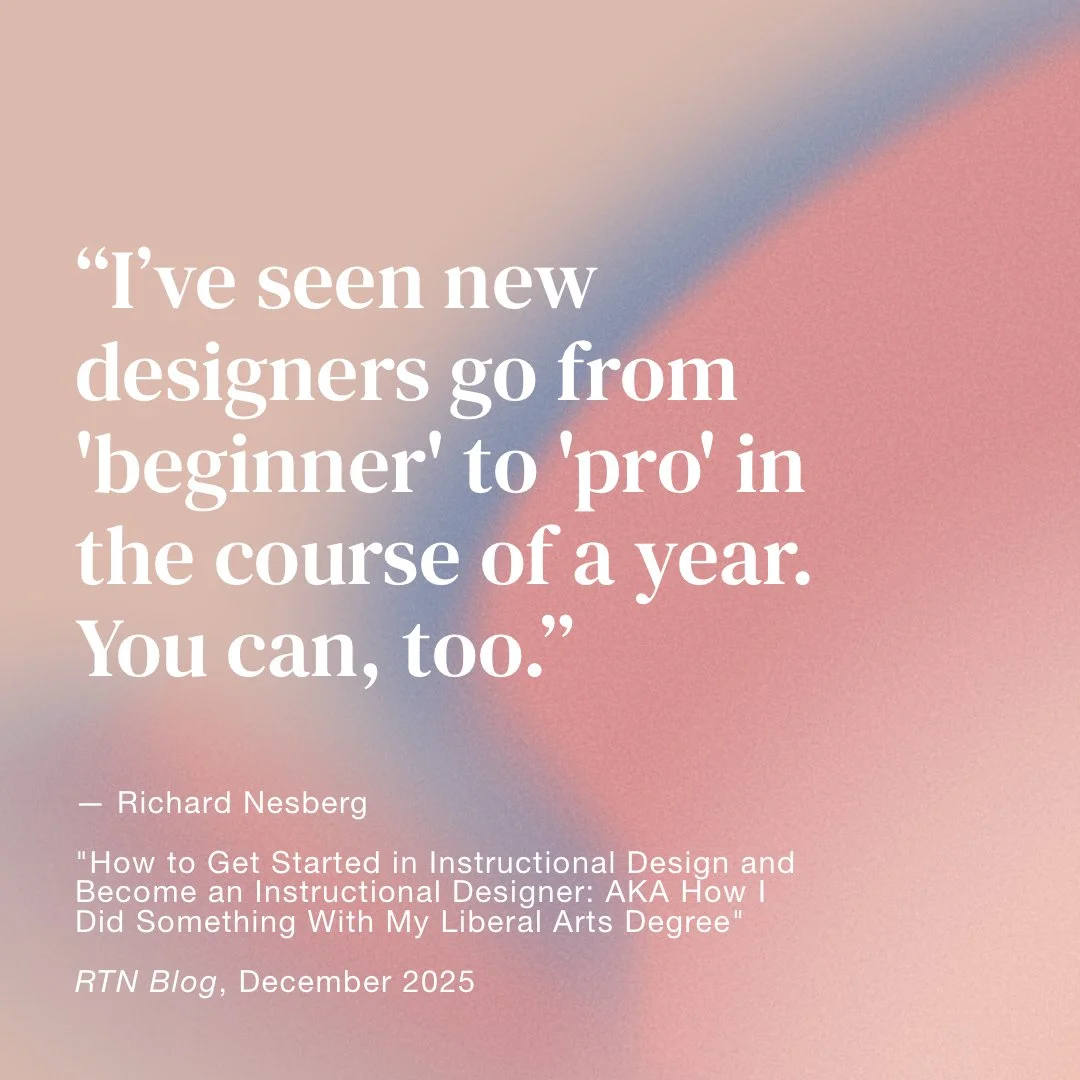
And it’s about adult learning, of course! Over the years, I’ve tried numerous learning methods, strategies, tips and tricks, and tech. Many people that encounter this world are daunted by it. If you learn the basics, get some practice, and integrate coaching feedback, you can become proficient quickly. I’ve seen new designers go from “beginner” to “pro” in the course of a year. You can, too.
What makes a good instructional designer?
It behooves the instructional designer to be a strong generalist, which is how I ended up doing something with my liberal arts degree (who wants to employ a Creative Writing major? LOL.).
They need to excel across multiple domains. Writing, multimedia content creation, working with technology and systems, managing stakeholders and projects, research and analysis, accessibility, and the retinue of jobs goes on and on. You wear all the hats. Few jobs in knowledge work require proficiency across so many unrelated domains.
How do I get started as an instructional designer?
Almost every instructional designer I’ve met did not even know what it was in college. I only met two people who thought to themselves growing up, “When I grow up, I want to be an instructional designer!” Everyone else stumbled onto this path and thought…hey, I kinda like this.
They tend to be top talent in their own role and organization. Game recognizes game, after all. When a training need emerges, leaders strapped with training resources often turn to their best and brightest subject matter experts (SME). “Hey, you’re really good at your job. Do you think you can write some of this down and share it with your team?”
If you’re EVER in that position—and interested in creating training—you’re on your way to becoming an instructional designer.
If you have a training team at your company, get connected with them. They might already be involved with the project you’ve been tapped to support. Learn about their quality standards. Use their templates. Mimic their designs and develop content like they do. Ask them for help, whether reviewing content or coaching. Find a buddy. Learn the teams. Find out whether they have any openings now or in the future. Make yourself known, helpful, and eager to learn more. Training teams need experts like you. It’s almost every instructional designer’s in to the industry.
If you don’t have a training team, you might be making one.
How do I learn everything that instructional designers are expected to do?
Start with an informal skills gap analysis. (You’ll do this later for learners.) Get a list of the domains that instructional designers at your company are expected to be good at. Rank yourself on a scale of 1 to 10. 1 means you’re a beginner and 10 means you’re a pro.
Don’t overthink this, you just want a self-assessment baseline on what aspects of the role you’ll thrive in and which you’ll need to increase knowledge or skills in to be successful. For example, as a born writer, my writing skills were fine but I needed to take training on coding so I could author interactive multimedia in HTML, Javascript, and CSS. (Don’t worry, you probably won’t need to learn these languages.) I favor the StrengthFinders CliftonStrengths approach where you double-down on what you’re good at and partner with people that are good in areas where you struggle or have a weakness. Make a plan to work through these skills gaps over time. Even showing you’re earnestly trying can be sufficient.
Next, it’s time for my crash course in design. First of all, feel free to explore all of the approaches out there. You might find ideas that work well for you, your learners, or your company. You might find pieces of this and pieces of that you want to remix into a custom approach. The following approach is what I consider the core fundamentals of instructionally-sound content. If you adopt this approach, you’re going to create more engaging and relevant designs that improve outcomes better than content made without it.
Learn about Revised Bloom’s taxonomy. It’s how you can think about identifying the right altitude of cognition your training should be written at. Simpler stuff is at the lower Remembering level, where you just need learners to recall information. As content gets more complex, you move up the taxonomy. No level is better than the other. They’re all important angles for how humans construct and transfer knowledge. Select levels based off what you want learners to do in the classroom and on the job. Critically, it helps you know what level to write the training at and when and why you use a different level.
Strive to create cohesive, standalone learning objects. A learning object is a piece of training that can teach learners on its own without dependencies or even a teacher. It includes a discrete learning objective and the presentation of information, activities, and review (PAR) to support that objective.
Align your learning objectives and PAR to the same level of Bloom’s. It’s my tried-and-true approach to crafting a learning object. After a while, your experience will earn you some poetic license. Then, you can artfully play with the learning object, or set of learning objects, to elicit a specific path to knowledge and skill development that might deviate from what you learned in the basics. After major revisions, review this alignment to ensure everything remains copacetic.
Know your audience. Who’s consuming this training and what constraints do they have? Are they based in a specific region or do you have a global learner pool? Do they speak English? Will content be translated or localized for them? What’s their hiring profile? What does a job task analysis say about what they need to learn about to do their job well enough on day one? Do they like the training their assigned? Can you improve that experience?
Answer these questions and get clear about who’s taking this training. The constraint of your audience will dictate a lot of what you end up designing and developing. Honor adult learning theory, where you prioritize essential information only and acknowledge the wealth of experience that adults bring to the learning environment. Preserve their time and energy for what matters the most.
How do I authentically write training about a job I’ve never done?
Congrats, you’ve got imposter syndrome! It gets easier. You just gotta fake-it-til-you-make-it for a while. Your job now is to get good at explaining how to do jobs you will never do. It’s weird but you will get good at doing that. Work with SMEs. Be transparent when you don’t know and ask for them help. LLMs can fill the void here, invoke a persona-based reviewer to act like your SME—you can ask it “dumb” questions before bringing it to the SME. Build confidence in your craft and strengthen any skills that will help you overcome what’s making you feel like an imposter.
OK, that’s a lot. What else do I have to learn and do?
Well, it is a lot! And I barely got going…perhaps we’ll save more for another entry?
Outside of those basics, everything else will start to fill in as you get more experience with project management, stakeholder management, research and analysis, evaluation strategies, and so on. The eventual training org you join should have resources and processes to help you with these advanced aspects of the role.
Take some classes or certifications. There’s a ton of content out there from people like Cathy Moore and organizations like the Association for Talent Development. Read Robert Mager’s Preparing Instructional Objectives.
If you’re setting sails for instructional design, best of luck! Let me know if these tips help you in the comments.
- rtn
Richard Nesberg | Author of "Down the Rabbit Hole: Your Guide to Crypto Literacy"
📖 Order the book: [Amazon Link]
🌐 Visit: nesberg.com
📝 RTN Blog: nesberg.com/blog
🎁 SHARE THIS Know someone who'd benefit from this? Send it to them!